
End client: Caltrans
SR 9 Drainage Improvements (Santa Cruz Mountains)
Ben Lomond put in-house engineering and fabrication to work on three very different culvert installations.
Watch Film ↓BEN LOMOND / CULVERT REPLACEMENT
Start with the constraint.
Build the approach.
At Ben Lomond, each culvert crossing posed a different engineering problem. One had an existing steel obstruction, another had no room for a receiving pit, and the largest ended at a creek with limited equipment access. Phoenix designed and fabricated the tooling for each crossing and adapted its own equipment to install all three. The crossings below are shown in the order we built them.
The construction sequence below differs from the film’s presentation order. Dimensions distinguish the pipe’s inside diameter (ID) from its outside diameter (OD).
- 3
- Crossings, each with its own engineered approach
- 36 in
- First crossing: RCP ID / 44 in OD
- 30 in
- Second crossing: RCP ID / 36 in OD
- 120 in
- Third crossing: RCP ID / 144 in OD
01 / CONSTRUCTION SEQUENCE
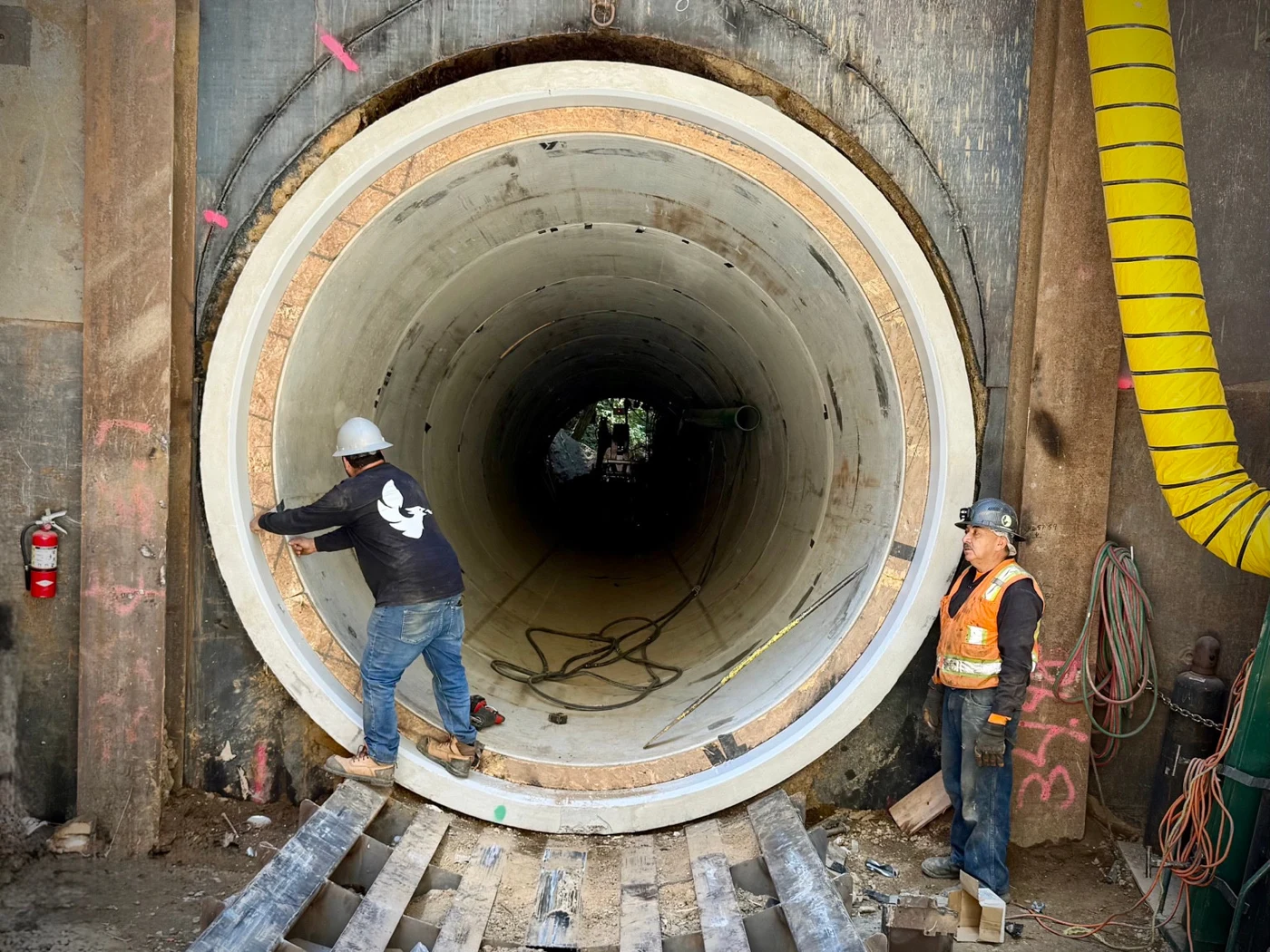
36-inch RCP: A cutting head designed for the existing culvert
The first crossing followed the alignment of an existing 18-inch corrugated metal pipe (CMP). Phoenix designed and fabricated a custom head that cut through the old metal pipe and allowed a new 36-inch-inside-diameter reinforced concrete pipe (RCP) to be installed in its place. The cutting head was built specifically for the existing pipe and the new culvert alignment.
02 / CONSTRUCTION SEQUENCE
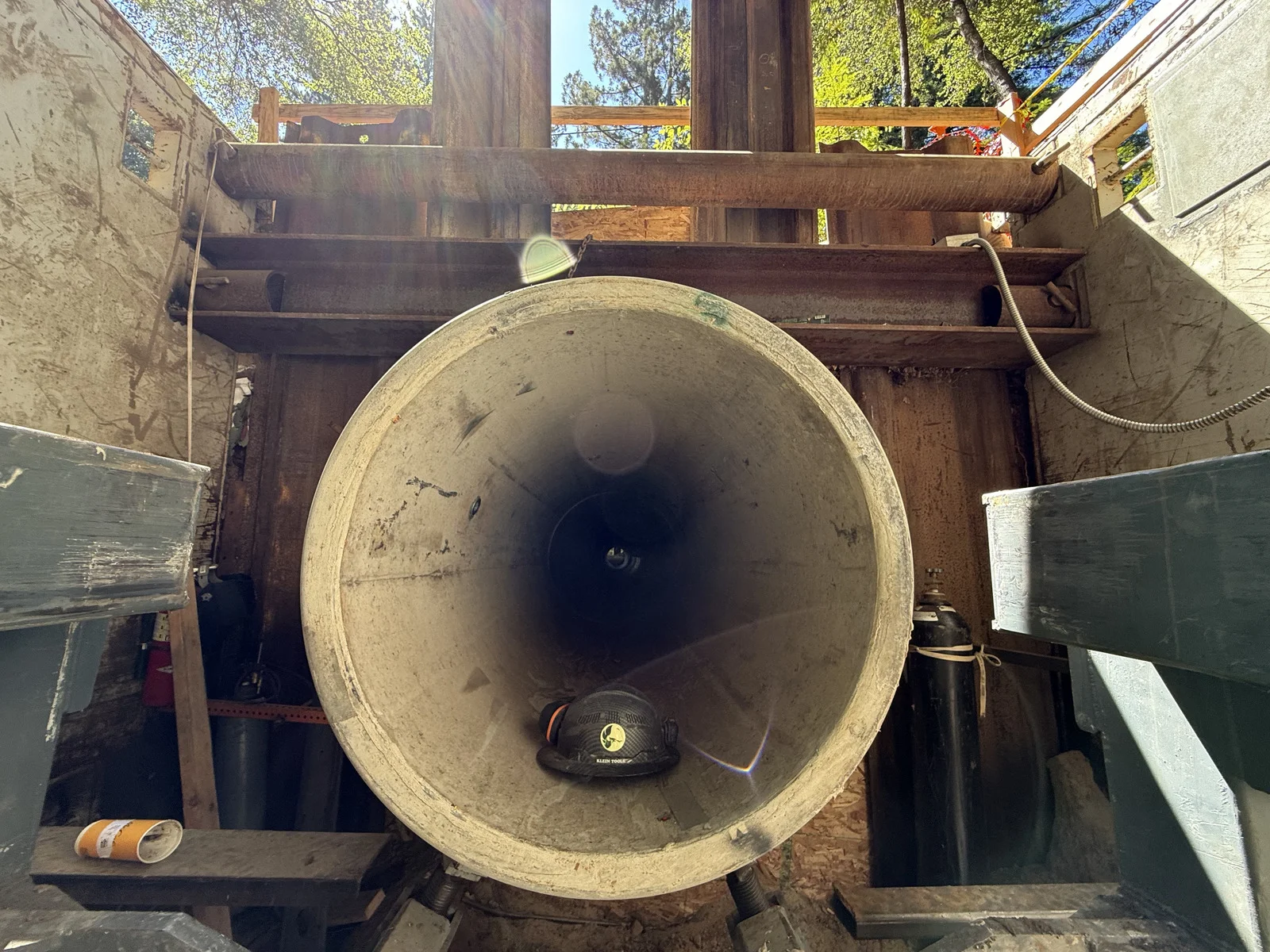
30-inch RCP: Guided installation without a receiving pit
The next crossing exited directly onto a hillside. There was no space for the equipment normally used in the receiving pit of a guided boring method (GBM) installation. Phoenix kept the guided pilot stage, then designed a lightweight front reamer to transition to guided auger boring with a 36-inch steel casing, matching the outside diameter of the new concrete pipe. Short pilot rods could be retrieved at the slope without receiving-pit equipment.
Once the casing was in place, the crew used pipe substitution: the new jacking-grade RCP displaced the temporary steel casing, which was removed in sections at the hillside. The approach preserved pilot guidance while fitting the space available at the exit.
03 / CONSTRUCTION SEQUENCE
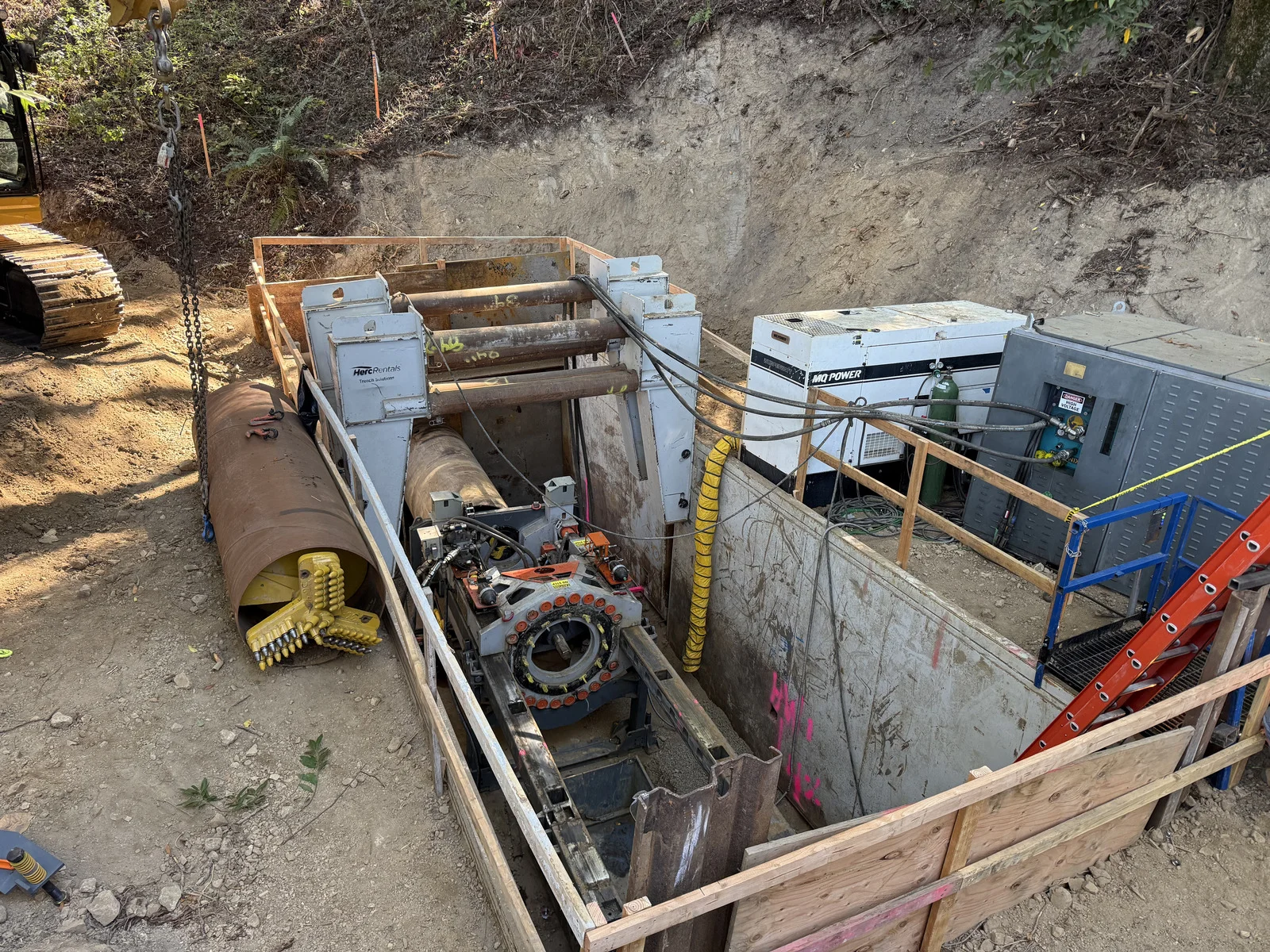
120-inch ID RCP: A sectional jacking shield for a creekside exit
The last crossing was about 144 feet long, but the concrete pipe measured 120 inches inside and 144 inches outside. At that size and length, a conventional tunnel boring machine was a poor economic fit. Retrieving a full-sized cutterhead at the creek would also have been difficult.
Phoenix designed a sectional shield for pipe jacking and adapted its ADB48, originally designed for pipe up to 48 inches, to push the 144-inch-OD concrete pipe. Engineering checked the anticipated jacking loads and ground conditions. The team built the thrust adapter, shield and excavation tooling, and adapted the hydraulics so the front-end excavation equipment could run from the ADB48 power pack. At the creek, the shield could be broken down and the sections retrieved individually by excavator.
DESIGN THROUGH DELIVERY
The difference was
the ability to adapt.
All three crossings relied on the same ability: the people who designed and fabricated the tools also worked with the crews who had to use and recover them. The result was a different installation approach for each constraint, with one team accountable from design through construction.
PROJECT FILM
Watch the project film
Project-specific approaches developed for these conditions and constraints. The film’s second crossing is the 36-inch-ID installation completed first.