Two samples. One best guess.
Before sampling, the ground profile is unknown. Two samples tell us what’s at the ends of the crossing. Everything in between is an estimate.
For Investors
We design the equipment, build it in-house and put it to work installing underground utilities. Our modular platform lets the same base machine switch boring methods as the ground and the job demand.
THE UNDERGROUNDING CHALLENGE
Utilities need to harden power grids and replace aging water and sewer lines. Trenchless construction can keep roads open and limit surface disruption. But what lies between the launch and reception pits can make a crossing harder to price.
Before sampling, the ground profile is unknown. Two samples tell us what’s at the ends of the crossing. Everything in between is an estimate.
Suppose the crew can sample four more spots along the route, all from dry ground. Each sample shows the layers at that location, not the full picture.
The revised profile puts unstable ground and bedrock in the pipe’s path. What happens if the crew sticks with the setup it picked for stable ground?
Before the first sampleThe surface is visible. The layers beneath it aren’t.
Soil sampling 1 · Receiving sideThe rig finds stable ground, then unstable ground, then bedrock.
Soil sampling 2 · Launch sideThe second sample finds the same sequence.
Projected from two samplesIf those layers continue between the two points, the proposed pipe stays in stable ground.
What if we took more samples?Set the first projection aside and collect four more samples between the ends.
Just past the highwayUnstable ground is closer to the surface than the end samples suggested.
Just past the railroadThe top of the unstable layer is at a different depth again.
At the near bankBedrock is much shallower here.
At the far bankThe layers drop again. The rig stays on dry land.
A clearer picture of the crossingThe proposed pipe hasn’t moved. The new profile suggests it cuts through two layers the crew didn’t plan for.
What happens if the crew ignores the ground?Imagine they bore with the setup they chose for stable ground.
A smooth startThe auger advances through stable ground. The surface holds.
Ground loss in unstable groundThe void grows as the cutter passes. Then cracks work their way up to the highway and the tracks shift.
Stalled at hard rockThe cutter and auger stop turning. The rig never reaches the stable ground beyond.
Illustrative failure scenario, not a recommended field response.
WHY IT SHOWS UP IN THE PRICE
It’s not a separate charge. It’s the contingency contractors build into bids to cover possible delays, equipment changes, or specialist help when ground conditions differ from the plan.
Phoenix’s approach: Our modular platform lets us change boring methods on the same base machine when conditions allow. If a crossing needs something we don’t already have, we can engineer it in-house. That doesn’t eliminate geological uncertainty, but it gives us more ways to handle it.
Our Solution
Phoenix’s 6-in-1 platform gives crews options a single-purpose machine doesn’t. The same base machine adapts to different diameters, alignment tolerances and ground conditions by changing tooling, settings or the boring method itself.
Conventional methods cover many crossings. Assisted Dynamic Boring is built for unstable ground, and Jet Bore is in development for hard rock. If a crossing calls for a tool we don’t have, we can design and build it in-house.
We compete on straightforward crossings, but our advantage is greatest in difficult or variable ground. Having more than one way to finish a drive reduces our reliance on any single ground assumption and lets us pursue more jobs.
We look first at regions where difficult or mixed geology can limit the number of contractors equipped for the work. Those are the markets where the ability to change methods on the same machine can matter most.
Company Traction
Phoenix began operating in Q3 2024. Track how contract bookings, financing and field capacity grew as the early jobs turned into a repeatable construction business.
Operating Progress
USD millions and operating counts · selected checkpoints
Hover or tap the chart, or use the arrow keys to move between quarters.
| Quarter | Contract bookings | Capital raised | Full crews | Active Machines | Milestone |
|---|---|---|---|---|---|
| Q3 2024 | — | ~$1M | Founder-led | — | Operations began with a lean team and project partnerships; first SAFE financing. |
| Q4 2024 | ~$2M ARPA-E award; total not reported | ~$1.34M | — | 1 recommissioned | First public bid won. ARPA-E cooperative agreement became active; first ADB recommissioned. |
| Q1 2025 | ~$2.6M | ~$1.93M | — | 2 | Second ADB recommissioned. Early SAFE capital shown as the cumulative tranches in the company presentation. |
| Q2 2025 | ~$3.5M | ~$2.23M | — | 2 | Early SAFE funding reached about $2.23M; first project accessories fabricated in-house. |
| Q3 2025 | ~$5M | ~$2.23M | — | 2 | Field delivery advanced. |
| Q4 2025 | ~$6M | ~$2.23M | — | 2 | Field delivery continued, including Paradise Drive. |
| Q1 2026 | ~$8M | ~$4.64M documented | 1 | 2 | Priced Seed closed; previously issued SAFEs converted. First full crew mobilized for North Perris. |
| Q2 2026 | ~$10M | ~$4.64M documented | 1 | 2 | Commercial bookings reached approximately $8M, plus the ARPA-E award. |
| Q3 2026 | ~$12M in forward bookings (August) | ~$5.64M documented | 2 | 3 | July’s $1M working-capital SAFE supported the summer workload. Two full crews first split at Sunnyslope, and a third machine was available by Q3. |
June 2024
Operations began the next quarter with a founder-led team and early SAFE financing.
Q4 2024
First public bid won and a U.S. Department of Energy ARPA-E cooperative agreement launched PyroHDD development.
2025
Recommissioned a second machine, fabricated project tooling in-house and grew the commercial book to about $4M.
Q1 2026
Early SAFEs converted. The round added new capital to support the move toward multi-crew operations.
Q3 2026
A $1M SAFE supported the summer construction workload. The first two-crew split came at Sunnyslope.
Operating Model
Our field crews and engineers work together to identify where a method, cutter or adapter needs to change, then test the result.
Building equipment and tooling in-house lets us adapt a machine to the job rather than accept the limits of an off-the-shelf setup.
Phoenix earns revenue delivering trenchless crossings. New engineering goes back into the field with the team that helped define it.
Our Founding Story
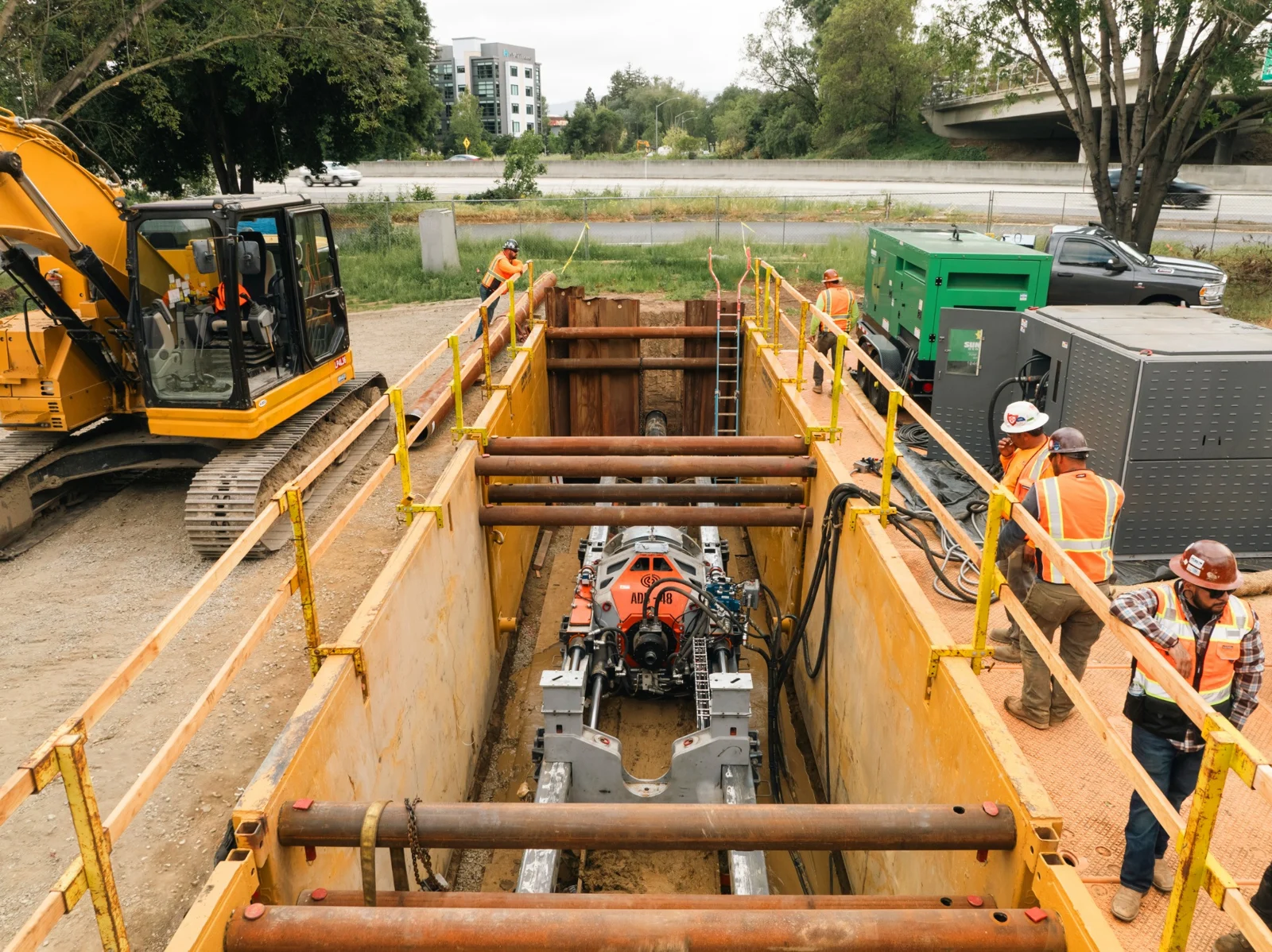
Phoenix Boring grew from two complementary technologies: Zilper’s approach to unstable ground and Petra’s approach to hard rock. A PG&E crossing in California helped turn that engineering into a contractor that designs, builds, and operates its own equipment.
Read our storyInvestor Conversations
Our ambition is to make Phoenix a national jack-and-bore contractor and, over time, to bring the platform to international markets. The next step is delivering more crossings with multiple crews and entering regions where complex geology gives our equipment a meaningful advantage.
Targeted undergrounding can reduce exposure to wildfire. At the same time, utilities need to add electrical infrastructure to support rising loads, including AI data centers. Both needs create crossings where the grid must expand without unnecessarily disrupting the surface.
U.S. Department of Energy · ARPA-E
Backed by ARPA-E’s GOPHURRS program, Phoenix is developing a horizontal directional drilling system intended to install electrical conduit through mixed geology, including hard rock. PyroHDD pairs thermal spallation with other drilling capabilities. The goal is to make more underground routes practical; the system is in development, not a commercial service.
Read the DOE project description
Explore PyroHDD